
Behind the word “durable” lies a precise balance of material grade, plating process, wire diameter, and heat treatment. These parameters not only determine how long your finished folders will last, but also directly impact your production line efficiency – such as riveting yield, assembly speed, and tool wear. Rather than listing standards, we want to help you understand the key processes from a manufacturing perspective.
1. Material: Affects Your Assembly Yield and Tool Life
Our metal binder rings are based on cold-rolled iron sheet. Different grades are used for different products:
- Standard cold-rolled iron: Good formability, suitable for complex shapes (like butterfly clips), cost-effective.
- Hardened iron (medium carbon content): Higher strength, good elasticity after heat treatment, ideal for springs and load-bearing rings. Slightly higher tool wear and cost.
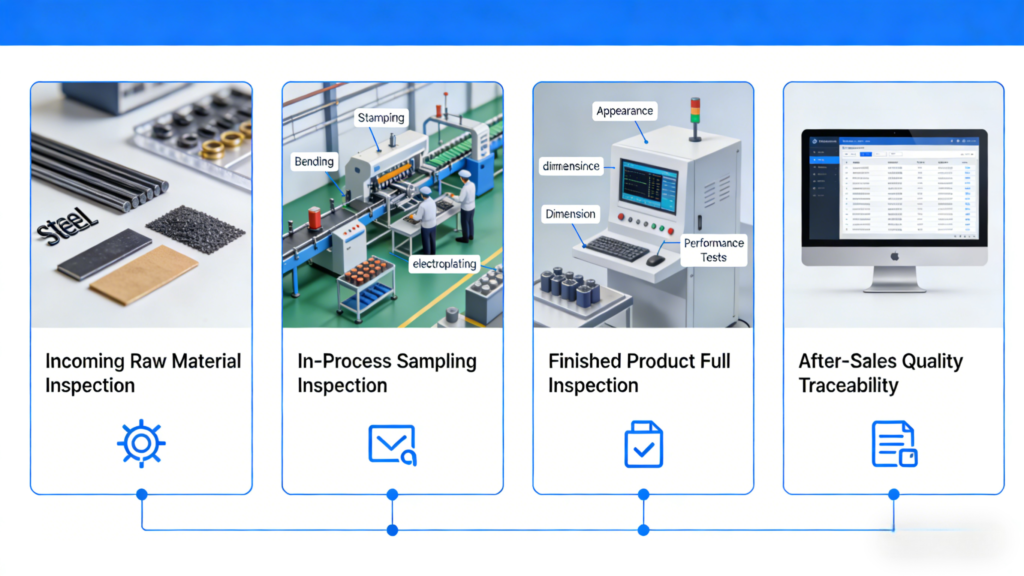
For your production line: If you use automated equipment to rivet rings onto folders, material hardness consistency is very important. Variations can cause weak riveting or damage to your tooling. We check hardness for every batch and provide batch reports, so your line keeps running.
2. Plating: Determines Corrosion Resistance and Riveting Smoothness
Salt spray test performance depends directly on plating type and thickness:
- Zinc plating: Standard 3-5μm gives 12-24 hours; thickened 8-12μm + passivation gives up to 72 hours.
- Nickel plating: 5-8μm gives 48-72 hours; multi-layer nickel can exceed 96 hours.
For your production line: Too thick or uneven plating may affect how tightly the ring fits when riveted. We control plating thickness tolerance within ±1μm and perform adhesion tests to ensure no peeling during stamping or riveting.
3. Spring: Affects the Consistency of Your Finished Product’s Feel
90% of the opening/closing feel of ring mechanisms and lever arch clips comes from the spring.
- Wire diameter: 0.8–1.5mm. Thicker wire means stronger force.
- Material: Piano wire (SWP-B) offers better fatigue life than standard spring wire.
- Heat treatment: Tempering at 400–450°C, with force decay less than 8% after 10,000 cycles.
For your production line: Spring force consistency directly affects how your finished folders feel. If some are loose and some are tight, your customers will perceive unstable quality. We use high-quality piano wire and perform 100% force sampling, with tolerance within ±5%, so every folder you assemble feels the same.
4. Hinge Structure: Affects Long-Term Tightness
The two halves of a ring are connected by a hinge. We use a double-pivot pin structure that stays tight even after 20,000 open/close cycles.
For your production line: This structure is more friendly to riveting. The pin is precision-ground to avoid misalignment during riveting, reducing your machine setup time. Axial clearance is controlled within 0.1mm to prevent ring wobble after assembly.
What we want to say:
Next time you evaluate a component supplier, feel free to ask us three questions:
Our goal is to provide you with more professional and accurate quality support. From material hardness to plating thickness and spring force consistency, we don’t just ship components – we share clear, verifiable data so you can trust what goes into your production line. Tell us your quality requirements, and we’ll help you meet them, batch after batch.