
TL;DR
Eyelets are two-piece metal rings installed into fabric, leather, paper, or plastic to reinforce holes, prevent tearing, and allow cord or hook attachment. Hollow rivets are tubular metal fasteners used to permanently join layers of material — most commonly for installing ring binder mechanisms, lever arch clips, and bag hardware. Jinxinyu Hardware supplies both in multiple sizes, materials, and finishes (nickel, gold, antique brass, colored), and provides matching installation machines from manual tools to fully automatic eyelet presses. OEM customization and low MOQ available for stationery, bag, footwear, and packaging industries.
1、Eyelet vs. Hollow Rivet: Understanding the Core Difference
| Feature | Eyelet | Hollow Rivet |
| Primary Function | Reinforce holes; prevent tearing; enable cord/hook attachment | Permanently join multiple material layers; install hardware fittings |
| Structure | Two-piece ring (front ring + washer); visible on both sides after installation | Tubular metal pin; one end flares out on installation to lock |
| Installation Method | Eyelet press machine stamps the two rings together | Rivet press machine flares the tube end to lock in place |
| Visual Result | Decorative metal ring visible on both front and back | Cap visible on front; flared edge on back |
| Key Applications | Fabric cord holes, canvas reinforcement, paper decoration holes, bag hanging holes | Binder mechanism installation, bag hardware fixing, leather goods joining |
| Material Compatibility | Fabric, leather, paper, plastic, canvas | Card, leather, metal sheet, fabric |
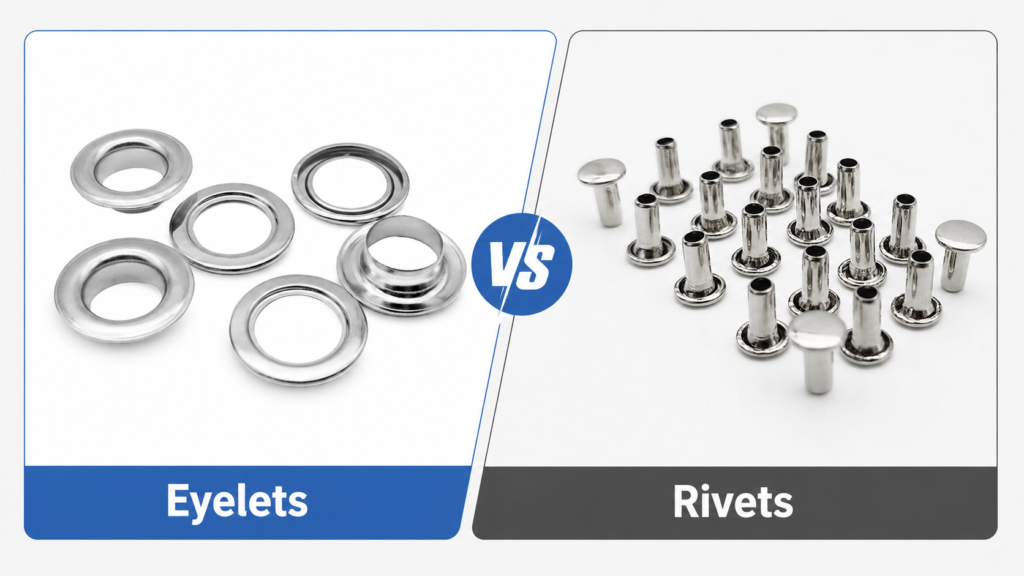
2、Eyelets: In-Depth Guide
What Is an Eyelet?
An eyelet is a two-piece metal fitting consisting of a front ring and a back washer. The front ring passes through a pre-punched hole from the material’s front face; the washer is placed on the back. An eyelet press then stamps the assembly, causing the washer to flare outward and lock both pieces flush against the material — creating a clean, durable, metal-reinforced hole.
Primary Applications
- Canvas bags and canvas shoes: cord holes and lace holes (most common use)
- Handbags and backpacks: hook attachment holes, ventilation holes
- Binders and notebooks: decorative metal hole accents
- Banners, flags, and canvas displays: fixing and hanging holes
- Leather goods (belts, wallets, bags): functional punch holes
- Footwear (dress shoes, sneakers): shoelace hole reinforcement
Eyelet Key Specification Parameters
| Parameter | Description | Typical Range |
| Outer Diameter | Diameter of the installed outer ring; determines visible size | 8mm – 30mm+ |
| Inner Diameter | Diameter of the center hole; determines cord/rope clearance | 3mm – 20mm |
| Height / Length | Length of the tubular shank; must exceed material thickness | Matched to material thickness |
| Material | Brass, iron, zinc alloy, stainless steel | Selected by strength and corrosion needs |
| Surface Finish | Nickel plating, gold, antique brass, colored coating | Matched to product aesthetic |
Eyelet Color Options
| Finish | Appearance | Best Product Application |
| Silver / Nickel | Classic bright silver; most universal | Canvas bags, stationery, general products |
| Gold | High-gloss gold plating | Premium handbags, gift packaging, luxury stationery |
| Antique Brass | Aged warm brass tone | Vintage leather goods, artisan craft products |
| Colored (Red/Blue/Green/Black) | Vivid colors; high visual impact | Children’s products, sports brands, creative stationery |
| White | Clean white coating | White canvas bags, minimalist product lines |
3、Hollow Rivets: In-Depth Guide
What Is a Hollow Rivet?
A hollow rivet (tubular rivet) is a cylindrical metal fastener with a hollow center. It is inserted through a pre-drilled hole in the materials being joined, and then a rivet press machine flares out the trailing end of the tube, creating a permanent mechanical lock that holds the layers together. Compared to solid rivets, hollow rivets are lighter, easier to install, and suitable for a wider range of material thicknesses.
Primary Applications
- Ring binder mechanism installation — the most critical use in stationery manufacturing
- Lever arch clip base plate fixing to cover boards
- Board clip (clipboard clip) installation
- Handbag and leather goods hardware fixing (D-rings, magnetic clasps)
- Footwear component joining
- Packaging box hardware riveting
Hollow Rivet Key Specification Parameters
| Parameter | Description | Jinxinyu Available Range |
| Cap Diameter (A) | Outer diameter of the rivet head cap | 3mm – 12mm+ |
| Shank Diameter | Outer diameter of the hollow tube section | 2mm – 8mm |
| Shank Length (B) | Length of the tube; must match total material thickness plus flare allowance | Custom to material thickness |
| Material | Iron, brass, aluminum, stainless steel | Selected by strength requirement |
| Surface Finish | Nickel, gold, antique brass, matte black | Matched to accompanying hardware color |
4、Double Head Rivets: When Both Sides Need to Look Good
A double head rivet (double cap rivet) has a metal cap on both ends — front and back — giving a clean, finished appearance on both faces of the material. This makes it the preferred choice for visible leather goods and premium bag hardware where the back face is exposed.
| Feature | Detail |
| Structure | Two-piece: front cap + back cap; both caps visible after installation — no exposed flare edge |
| Primary Use | Leather bags, belts, wallets; decorative and functional hardware fixing on premium goods |
| Aesthetic Advantage | Both sides show a clean round metal cap; no visible flaring or raw edges |
| Common Sizes | Cap diameter 6mm – 12mm; shank length 4mm – 15mm |
| Available Finishes | Bright nickel (silver), gold, antique brass, matte black, rose gold |
5、Installation Tools: Choosing the Right Equipment
| Tool Type | Best For | Output Rate | Recommended User |
| Manual Eyelet Tool / Die Set | Prototyping, DIY, very small batches | 1 piece per operation; ~10-30/hour | Sampling stage, craft brands, small workshops |
| Hand Press Machine | Small-to-mid batch; more consistent than manual tools | ~50-200/hour | Small factories, accessory workshops |
| Desktop Press Machine | Mid-to-large batch; semi-automatic operation | ~200-500/hour | Mid-size factories, stationery hardware producers |
| Fully Automatic Eyelet Machine | High-volume automated production | 1,000+/hour | Large stationery factories, bag factories, shoe factories |
Best practice: always prototype with a manual tool first to confirm eyelet or rivet size and material compatibility before committing to automated production.
6、Eyelet Installation: Step-by-Step Process
- Step 1: Mark hole positions on the material and punch clean round holes using a hole punch tool (hole diameter should be slightly smaller than the eyelet inner diameter)
- Step 2: Insert the eyelet front ring through the hole from the material’s front face
- Step 3: Place the eyelet washer over the protruding tube from the material’s back face
- Step 4: Place the assembled material onto the eyelet press die, centered under the punch
- Step 5: Activate the press — the stamping force causes the washer to flare outward, locking both rings tightly against the material
- Step 6: Inspect the installation — both sides should be flat, smooth, and free of burrs or sharp edges
Data source: Jinxinyu Product Catalog, 2026 Edition — Eyelet Installation Process Diagram
7、Material and Finish Selection Guide by Application
| Application | Recommended Material | Recommended Finish | Key Reason |
| Canvas bag cord holes | Brass or iron | Nickel or colored | High strength; friction-resistant; color coordinates with bag body |
| Premium leather goods decoration | Brass | Gold or antique brass | Brass resists cracking; delivers luxury aesthetic |
| Stationery binder mechanism installation | Iron or zinc alloy | Nickel | Adequate strength; cost-effective; color matches binder hardware |
| Shoe lace holes | Iron or stainless steel | Nickel or matte black | Wear and corrosion resistant; withstands repeated lacing |
| Outdoor canvas / banner fixing holes | Stainless steel or brass | Nickel or natural | Weather-resistant; rust-proof in outdoor conditions |
| Children’s product decoration holes | Zinc alloy | Colored RoHS-certified coating | Must pass RoHS; no heavy metals; child-safe materials |
Data source: Jinxinyu Product Catalog, 2026 Edition
8、FAQ: Eyelets and Rivets
Q1: What is the difference between an eyelet and a grommet?
The terms are often used interchangeably, but technically: eyelets are the smaller variant (inner diameter 3mm-10mm), commonly used in fabric, leather, and paper; grommets are larger (inner diameter 10mm+), typically used in canvas, industrial materials, banners, and tarps. Jinxinyu supplies both size ranges. When ordering, always specify inner diameter and material thickness to ensure the correct selection.
Q2: Will an eyelet pull out of the material under load?
A correctly installed, quality eyelet in an appropriate material will not pull out under normal use. Pull-out resistance depends on three factors: (1) eyelet wall thickness and material (brass and thick-walled iron are strongest); (2) installation press force — use a proper press machine, not a hammer; (3) pre-punch hole size — a hole that is too large will cause the eyelet to sit loose and fail under load. Jinxinyu eyelets are produced to consistent dimensional standards; test reports are available on request.
Q3: Are ring binder mechanisms installed with eyelets or hollow rivets?
Ring binder mechanisms are installed using hollow rivets (tubular rivets). The rivet passes through the mounting holes in the mechanism base plate and the pre-drilled holes in the cover board; the rivet press flares the trailing end to create a permanent mechanical lock. Eyelets are used for cord holes, ventilation holes, and decorative ring holes — they are not interchangeable with rivets for structural hardware installation.
Q4: How durable are colored eyelet coatings?
Jinxinyu colored eyelets use electroplating combined with color coating for good abrasion resistance in normal use. For high-friction applications (such as shoe lace holes), choose electroplated colored finishes rather than paint-only coatings, or select inherently durable dark colors like matte black or antique brass. All colored variants are RoHS-certified; test reports are available.
Q5: Can eyelets be installed on paper and card stock?
Yes. Installing eyelets on paper and card is common in file folder covers, gift packaging, hang tags, and label cards. For paper applications, choose small eyelets (inner diameter 3mm-6mm) and use carefully controlled press force to avoid tearing or deforming the paper. A backing material (thin foam or card) under the paper during pressing can improve installation quality on thin stock.
Q6: How do I calculate the correct hollow rivet shank length?
The shank length must equal the total thickness of all materials being joined, plus a flare allowance of approximately 1.5mm-2mm. Formula: Shank Length = Total Material Thickness + 1.5mm to 2mm. Example: if total material thickness is 3mm, order shank length 4.5mm-5mm. Always prototype before production to confirm the flare creates a flat, secure lock without splitting or under-flaring.
Q7: Can Jinxinyu’s installation machines be purchased separately?
Yes. All four machine types — manual die sets, hand press machines, desktop press machines, and fully automatic eyelet-rivet machines — are available to purchase independently from Jinxinyu. They can also be ordered as a package with your eyelet or rivet order. Contact our sales team for machine specifications and pricing.
Q8: What certifications are needed to export eyelets and rivets to Europe and North America?
The primary requirements are RoHS certification (restricting lead, mercury, cadmium, and other hazardous heavy metals) and REACH compliance for the European market. For children’s product applications, additional testing to EN71 (EU toy safety) or CPSIA (US Consumer Product Safety Improvement Act) standards may be required. Jinxinyu products are RoHS certified; official test reports are provided with every order.
All specifications in this article are sourced from the Jinxinyu Hardware Product Catalog (2026Edition). For samples, spec confirmation, or OEM customization, contact us directly.
Website: https://newworldstationery.com/
Alibaba International: https://jinxinyu.en.alibaba.com/
Email: michelle@jxystationery.com