
Abstract
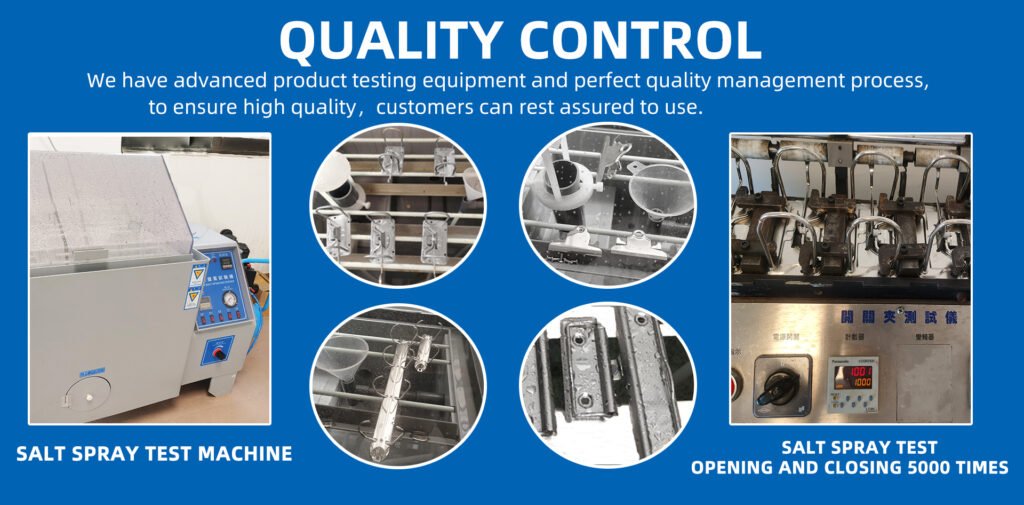
Salt spray testing is one of the most widely used methods to evaluate the corrosion resistance of stationery hardware products such as ring binder mechanisms, lever arch clips, and clipboard clips. This article explains how salt spray testing works, why it matters, and how manufacturers like Foshan Jinxinyu Hardware Products Co., Ltd. use it to ensure product durability and surface quality stability.
1. Introduction
Stationery hardware products are mostly made from iron materials, which are naturally prone to corrosion without proper surface treatment.
In real-world usage environments such as offices, schools, and humid regions, products may be exposed to:
Moisture/Oxygen/Finger contact/Temperature variation
Salt spray testing is used to simulate these conditions in a controlled laboratory environment.
2. What Is Salt Spray Testing?
Salt spray testing is a standardized corrosion test where metal samples are exposed to a fine mist of salt solution.
The goal is to evaluate:
Rust resistance/Coating durability/Surface protection quality/Long-term performance stability
Technical Reference
According to ASTM B117, salt spray testing provides a standardized method for evaluating corrosion resistance of metallic coatings under accelerated conditions.
Source: ASTM B117 Standard Practice for Operating Salt Spray Apparatus
3. Why Salt Spray Testing Matters
Corrosion is one of the most common failure modes in stationery hardware.
Potential Issues Without Testing
| Problem | Impact |
| Rust formation | Product failure |
| Surface peeling | Appearance degradation |
| Weak coating adhesion | Short lifespan |
| Color change | Poor product perception |
4. Testing Procedure Overview
Salt spray testing follows a controlled process.
Test Steps
| Step | Description |
| Sample preparation | Cleaning and drying |
| Salt solution preparation | NaCl concentration control |
| Exposure phase | Continuous spray environment |
| Observation | Periodic inspection |
| Evaluation | Rust level assessment |
5. Test Duration and Evaluation
Different products require different test durations.
Duration Table
| Product Type | Typical Test Duration |
| Standard nickel plating | 24–48 hours |
| Improved coating | 48–72 hours |
| High-end chrome finish | 72–96 hours |
| Industrial grade | 96+ hours |
Evaluation Criteria
No visible rust spots/No coating peeling/No blistering/No discoloration
6. Surface Treatment Impact
Salt spray resistance depends heavily on surface finishing quality.
Comparison Table
| Surface Finish | Corrosion Resistance | Performance Level |
| Nickel Plating | Good | Standard |
| Matte Nickel | Better | Premium |
| Chrome Plating | Excellent | High-end |
| Zinc Plating | Moderate | Low-cost |
Technical Reference
Based on the Foshan Jinxinyu Hardware Product Catalog, nickel plating is widely used in stationery hardware due to its balanced cost and corrosion resistance performance.
7. Manufacturing Factors Affecting Salt Spray Performance
Several production factors influence corrosion resistance.
Key Factors
| Factor | Influence |
| Material quality | High |
| Plating thickness | High |
| Surface cleanliness | High |
| Process stability | High |
| Storage conditions | Medium |
8. Quality Control Application
Salt spray testing is integrated into quality control systems.
QC Integration
| Stage | Purpose |
| Incoming inspection | Material verification |
| Process control | Plating consistency |
| Final inspection | Performance validation |
| Batch sampling | Stability check |
Technical Reference
According to Foshan Jinxinyu Hardware Products Co., Ltd. internal QC procedures, salt spray testing is a key validation step for plated stationery hardware before mass production approval.
Source: Foshan Jinxinyu Internal Quality Control Procedures
9. Common Buyer Misunderstandings
Many buyers misunderstand corrosion testing.
Common Mistakes
Assuming all nickel plating performs the same
Ignoring test duration differences
Not requesting test reports
Focusing only on appearance
Overlooking environment differences
10. How Buyers Should Evaluate Corrosion Resistance
Evaluation Checklist
✓ Request salt spray test report
✓ Confirm test standard (ASTM B117)
✓ Verify coating type
✓ Check test duration
✓ Compare sample performance
11. Conclusion
Salt spray testing is a critical method for evaluating the durability and corrosion resistance of stationery hardware products.
It helps ensure that ring binder mechanisms and other metal components maintain performance in real-world environments.
Foshan Jinxinyu Hardware Products Co., Ltd. applies standardized salt spray testing as part of its quality control system to ensure stable and reliable product performance for global OEM customers.
12. FAQ
Q1: What is salt spray testing used for?
It is used to evaluate corrosion resistance of metal coatings.
Q2: Is salt spray testing mandatory?
Not mandatory, but widely used in quality verification.
Q3: How long should testing last?
It depends on product type and coating level.
Q4: Does nickel plating pass salt spray testing easily?
Yes, but performance depends on coating thickness and process quality.
Q5: Why is ASTM B117 important?
It is the global standard for salt spray testing procedures.