
TL;DR
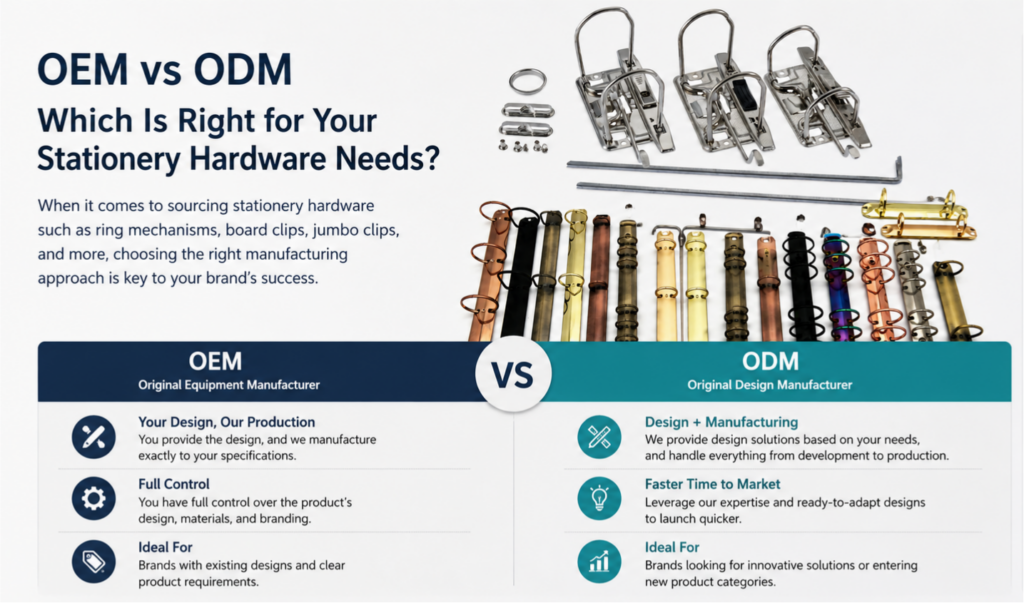
When it comes to sourcing stationery hardware such as ring mechanisms, board clips, jumbo clips, and more, one of the most critical decisions is choosing between OEM (Original Equipment Manufacturer) and ODM (Original Design Manufacturer). Each mode of production offers distinct benefits depending on your brand’s stage, needs, and goals. This article will explore the differences between these two modes and help you determine which is most suitable for your situation.
1、Core Definitions — OEM vs. ODM
The table below summarizes the key differences between OEM and ODM:
| Feature | OEM (Original Equipment Manufacturer) | ODM (Original Design Manufacturer) |
|---|---|---|
| Definition | Buyer provides complete design specifications; factory produces as per exact designs. | Factory provides existing designs; buyers select, modify, and sell under their own brand. |
| Design Ownership | Design belongs to the buyer (intellectual property stays with the buyer). | Design belongs to the factory; buyers get usage rights only. |
| Customization | Fully customizable: dimensions, color, material, structure, logo, etc. | Limited customization: typically logo, color, and surface finish. |
| Development Time | Typically takes longer (15-30 days for sampling). | Faster lead time (3-7 days for sampling). |
| Tooling Cost | Required for custom structures and new designs. | No tooling cost (uses existing molds). |
| MOQ | Generally higher. | Lower MOQ due to shared molds and predefined designs. |
| Differentiation | High — unique product; competitors cannot copy. | Low — same product may be sold to other brands. |
| Best For | Established brands needing unique products. | Startups or buyers testing new markets with limited budgets. |
2、What Can Be Customized in Stationery Hardware OEM?
When choosing OEM production for stationery hardware, buyers enjoy full control over the design. Here are the primary customization possibilities:
1. Dimensional Specifications
| Parameter | Description | Typical Use Case |
|---|---|---|
| Ring Center Distance | Adjusting spacing for non-standard paper or specialty covers. | Non-standard paper or specialty covers. |
| Inside Height | Customizing capacity for specific sheet counts. | Extra-thin or extra-thick planners and notebooks. |
| Overall Length | Adjusting base plate length for specific cover dimensions. | Non-standard formats or unusual binder sizes. |
| Base Width | Customizing width for ultra-slim or reinforced wide designs. | Tailored aesthetics or strong binding applications. |
2. Surface Color Customization
Buyers can select surface finishes from existing color ranges or request custom Pantone matching. Special treatments like matte, brushed, or laser finishes are also available.
- Basic colors: No additional charge.
- Custom colors: Small setup fees apply.
3. Logo and Brand Marking
Various processes are available to add branding to hardware:
- Silk Screen Printing: Cost-efficient, vivid colors, ideal for simple logos.
- Laser Engraving: Permanent and precise, best for detailed logos.
- Embossing: Adds a premium raised/recessed texture.
- Metal Label Plate: Attaches a separate branded tag for a luxury appeal.
4. Packaging Customization
Packaging options can also reinforce your brand image:
- OPP poly bags with branded insert cards.
- Custom color boxes with logo printing.
- Blister packs designed for retail display.
- Bulk packaging for B2B or factory shipments.
3、ODM Mode — Using Existing Designs
If you’re looking for speed to market or cost-effective solutions, ODM is your best choice. Jinxinyu offers a wide range of stationery hardware ODM products with customizable options.
| Product Category | Available ODM Options | Customizable Features |
|---|---|---|
| Ring Mechanisms | 2/3/4/6 rings; 10+ height specifications. | Color + logo printing. |
| Board Clips | 50-120mm lengths; 6 standard sizes. | Color, hanger type, and logo. |
| Jumbo Clips | JC50-JC146; 7 available sizes. | Color + logo printing. |
| Lever Arch Clips | Options for left and right hand. | Surface finish + logo. |
| Eyelets | Multiple diameters and 10+ colors. | Full color palette customization. |
| Protective Corners | 20+ predefined models. | Color preferences based on buyer needs. |
4、Choosing OEM or ODM Based on Brand Stage
Your choice between OEM and ODM should align with your brand’s current stage of growth and strategic priorities:
| Brand Stage | Recommended Mode | Key Reason | Typical Scenario |
|---|---|---|---|
| Early-Stage (0-1 Years) | ODM first | Minimize initial costs; test market quickly. | Validate demand before committing large orders. |
| Growth Stage (1-3 Years) | Mix of OEM & ODM | OEM for core products; ODM for supporting items. | Build differentiation while maintaining agility. |
| Mature Brand (3+ Years) | Full OEM | Ensure complete uniqueness and protect the brand. | Full proprietary designs with no competition. |
| Enterprise Procurement | Full OEM | Unified branding and high-quality output. | Group-wide standardized designs. |
5、OEM Process — Step by Step (Using Ring Mechanism as an Example)
- Submit Requirements: Provide a product drawing or spec sheet (e.g., ring spacing, dimensions, color, logo).
- Factory Assessment: Feasibility check and quotation from Jinxinyu.
- Sample Production: Pay a sample fee; samples are created in 7-25 days (depending on complexity).
- Sample Approval: Both parties sign a Sample Approval Sheet for confirmation.
- Bulk Production: Pay a 30% deposit; production completes within 15-25 business days.
- Quality Inspection: Photos and QC reports provided for approval.
- Balance Payment and Shipment: Pay the remaining balance; arrange freight.
6、FAQ about OEM and ODM
Q1: How much does OEM tooling cost? Is it worth it?
Tooling costs range from $500 to $3,000, depending on product complexity. Once a mold is created, it is a one-time charge, and future production uses the same mold without additional costs. For products with stable sales, tooling costs are usually recovered within 3-5 order cycles.
Q2: Can I secure exclusivity with ODM products?
No. For exclusivity, you must choose OEM and include exclusivity clauses in your contract. Some factories offer regional exclusivity agreements, but they typically require a minimum annual purchase volume.
Q3: How long does OEM sampling take?
- Color and logo changes: 3-7 days.
- Dimensional modifications: 7-15 days.
- New structural designs requiring tooling: 15-25 days.
7、Contact Us
For OEM quotations or ODM product catalogs, contact us:
- Website: Jinxinyu Official Website
- Alibaba: Jinxinyu on Alibaba
- Email: michelle@jxystationery.com