
TL;DR
An O-ring binder mechanism has fully circular rings that provide smooth, even page travel — the most versatile choice for everyday office, school, and planner products. A D-ring mechanism has one flat side that lies flush against the back cover, delivering 25%-30% more capacity within the same external binder size — ideal for high-capacity professional and presentation binders. Choose O-ring for smooth page turning and broad compatibility; choose D-ring when maximum capacity and neat page stacking are the priority. Jinxinyu Hardware manufactures both ring shapes with full OEM/ODM customization, low MOQ, and multiple surface finish options.
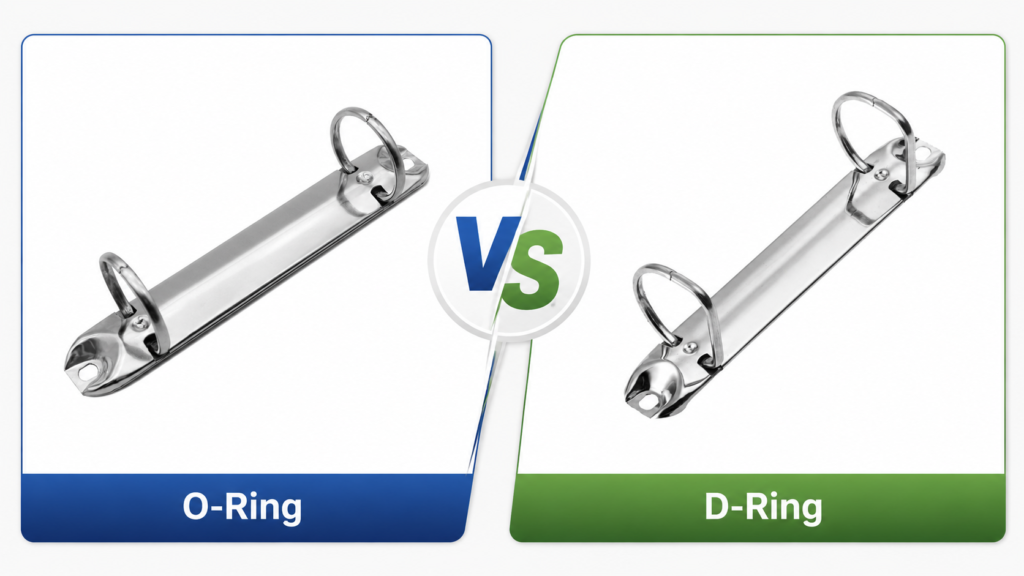
1、Why Ring Shape Affects Real-World Binder Performance
The shape of a binder ring determines how paper moves through the mechanism during page turns, how evenly weight is distributed across each sheet, and how much paper fits inside a given cover size. These are not cosmetic differences — they directly affect user experience, paper longevity, and the capacity your product can offer.
Despite this, ring shape is one of the most commonly overlooked specifications when buyers source binder hardware. This guide breaks down exactly what separates O-ring and D-ring designs, and how to match each to the right product.
Data source: Jinxinyu Product Catalog, 2026 Edition
2、O-Ring Mechanism: In-Depth
Shape and Structure
An O-ring binder mechanism features rings that form a complete circle when closed. Paper passes through the center of the ring and travels along the full circumference during page turns, creating an even, symmetrical arc of movement.
Key Advantages
- Smoothest page turning: paper follows a complete circular arc with no friction points or resistance
- Lower paper wear: even load distribution reduces stress at punch holes during frequent use
- Universal compatibility: works with all standard pre-punched loose-leaf paper without special hole specs
- Mature manufacturing process: lower production cost and stable supply — ideal for high-volume orders
- Versatile aesthetics: suits products across all price tiers, from economy to premium
Limitations
- Lower space efficiency: rings protrude symmetrically on both sides, occupying more interior cover space
- Slightly lower capacity per cover size: the circular path creates small gaps in the paper stack that reduce total page count
Best Use Cases for O-Ring
| Application | Why O-Ring Works | Typical Products |
| Daily office binders | Frequent page turning demands smooth, frictionless movement | A4 archive folders, meeting binders |
| Student loose-leaf notebooks | Heavy use; smooth rings reduce paper tear at holes | A4/A5 school notebooks, homework folders |
| Personal planners and diaries | Opened many times daily; O-ring delivers the best feel | Planners, desk diaries, calendar binders |
| Menu holders | Hospitality environments demand durable, smooth-opening products | Restaurant menu binders, hospitality folders |
| Sample and swatch books | Smooth page travel enhances the presentation experience | Product catalogs, color swatch books |
Data source: Jinxinyu Product Catalog, 2026 Edition
3、D-Ring Mechanism: In-Depth
Shape and Structure
A D-ring binder mechanism features rings with one flat side and one curved side, forming a D-shape in cross-section. When closed, the flat side sits flush against the interior of the back cover. This geometry allows the rings to sit closer to the cover surface, reducing outward bulk while maximizing usable interior space.
Key Advantages
- Greater capacity: D-ring mechanisms hold approximately 25%-30% more paper than O-ring mechanisms of the same inside height specification
- Neater page stacking: the flat side creates a stable surface for pages to stack against, keeping thick binders tidy and preventing page sag
- Better space utilization: rings lie flat against the back cover, making the overall binder profile more compact
- Professional appearance: D-ring is strongly associated with legal, medical, and institutional binders — signals quality and seriousness
Limitations
- Slightly less smooth page turning: the asymmetric arc creates minor friction as pages transition from flat to curved side
- Higher manufacturing precision required: the D-shape demands tighter production tolerances, resulting in marginally higher unit cost
- Directional installation: the flat side must face the back cover; installing it in reverse defeats the design advantages
Best Use Cases for D-Ring
| Application | Why D-Ring Works | Typical Products |
| Professional legal folders | High page count; neat stacking essential for document retrieval | Law firm binders, contract management files |
| Medical and government archives | Institutional use demands capacity, stability, and professional look | Patient record binders, government case files |
| High-capacity presentation folders | More content fits the same cover size; cleaner page display | Product catalogs, business proposal binders |
| Premium corporate gift binders | Compact profile and neat pages convey quality and precision | Custom gift folders, anniversary binders |
| North American office binders | D-ring is a widely expected format in the US professional market | Letter/Legal size office folders |
Data source: Jinxinyu Product Catalog, 2026 Edition
4、Full Comparison: O-Ring vs. D-Ring
| Feature | O-Ring | D-Ring |
| Ring Cross-Section | Complete circle | Half-circle + flat side (D-shape) |
| Page Turning Smoothness | Excellent; even arc, no friction | Good; slight asymmetric resistance |
| Paper Capacity | Standard | Approx. 25%-30% more per same cover size |
| Page Stack Neatness | Moderate; slight curve at both sides of stack | High; flat side keeps pages aligned |
| Interior Space Efficiency | Medium; rings protrude both sides | High; flat side lies flush with back cover |
| Cover Thickness Impact | Slightly larger footprint | More compact; better for slim cover designs |
| Manufacturing Complexity | Standard; lower cost | Slightly more complex; marginally higher cost |
| Best Use Frequency | High-frequency daily access | Low-to-medium frequency; storage and display |
| Installation Direction | No directional requirement | Flat side must face back cover |
| Primary Market | Global (all regions) | North America preferred; European professional |
| Main Product Types | Office folders, planners, diaries, menus | Legal binders, medical files, presentation folders |
Data source: Jinxinyu Product Catalog, 2026 Edition
5、How Much Capacity Difference Does Ring Shape Actually Make?
The D-ring capacity advantage comes from geometry: the flat side allows pages to stack flush with less wasted space at the base of each sheet. Here is a practical estimate based on standard 80gsm paper:
| Inside Height | O-Ring Approx. Capacity | D-Ring Approx. Capacity | Capacity Increase |
| 20mm | ~200 sheets (80gsm) | ~250-260 sheets (80gsm) | +25%-30% |
| 35mm | ~350 sheets (80gsm) | ~440-455 sheets (80gsm) | +25%-30% |
| 50mm | ~500 sheets (80gsm) | ~625-650 sheets (80gsm) | +25%-30% |
Note: figures above are theoretical estimates. Actual capacity varies with paper weight, hole punch precision, and how tightly pages are loaded. Always verify with physical samples before production.
Data source: Jinxinyu Product Catalog, 2026 Edition; industry reference data
6、Choosing by Target Market and Product Type
| Target Market / Product Type | Recommended Ring | Key Reason |
| North America office binders (Letter/Legal) | D-Ring | D-ring is market standard; buyers expect high capacity |
| European standard office folders (A4) | O-Ring | O-ring dominates European market; wider compatibility |
| Asian everyday folders and school notebooks | O-Ring | High-frequency use; smooth page turn is priority |
| Global planner and diary brands | O-Ring | Daily heavy use; O-ring delivers the best tactile experience |
| Legal, medical, and institutional archives | D-Ring | Professional setting; capacity and neat stacking required |
| Premium corporate gift binders | D-Ring or O-Ring | Depends on design; D-ring reads as more formal and serious |
| High-volume product catalogs and presentation folders | D-Ring | More content per cover size; better value per unit |
Data source: Jinxinyu export experience summary, 2026
7、Jinxinyu O-Ring and D-Ring Product Overview
O-Ring — Core Series (3-Ring Non-Booster)
| Series | Ring Spacing (mm) | Inside Height (mm) | Overall Length (mm) | Base Width (mm) | Best For |
| PR210 | 70 / 70 | 12 – 35 | 200 | 20 – 26 | Standard A4 office folder |
| PR264 | 108 / 108 | 11 – 50 | 253 | 20 – 26 | North America Letter binder |
| PR280 | 108 / 108 | 11 – 65 | 270 | 20 – 36 | High-capacity O-ring folder |
D-Ring — Core Series (3-Ring Non-Booster)
| Series | Ring Spacing (mm) | Inside Height (mm) | Overall Length (mm) | Base Width (mm) | Best For |
| PD123 | 80 | 16 – 38 | 114 | 20 | Lightweight D-ring folder |
| PD133 | 80 | 16 – 38 | 122 | 20 – 26 | Standard D-ring office folder |
| PD210 | 70 / 70 | 20 – 35 | 200 | 20 – 26 | A4 high-capacity D-ring binder |
Data source: Jinxinyu Product Catalog, 2026 Edition
8、FAQ: O-Ring vs. D-Ring
Q1: Can I use O-ring and D-ring mechanisms interchangeably on the same cover board?
Not usually. The two ring types often differ in base plate width, rivet hole spacing, and the interior cover profile required for correct installation. If you are considering switching between the two on an existing product, request a dimensional comparison sheet from Jinxinyu before committing to any cover board changes.
Q2: Is D-ring always more expensive than O-ring?
In most cases, D-ring mechanisms cost slightly more — typically 10%-20% above comparable O-ring specs — due to tighter manufacturing tolerances required for the D-shaped cross-section. However, given the 25%-30% capacity advantage, D-ring often delivers better value per unit of storage in high-capacity product applications.
Q3: What happens if a D-ring mechanism is installed with the flat side facing the wrong direction?
Installing a D-ring with the flat side facing inward (toward pages rather than the back cover) eliminates the capacity advantage, causes the binder to bulge, results in uneven page stacking, and puts incorrect stress on the ring joints. Always verify flat-side orientation during prototyping. Jinxinyu can provide installation diagrams with every order.
Q4: Are D-ring mechanisms suitable for planners and daily notebooks?
Not recommended for that use case. Planners and daily notebooks depend on smooth, frictionless page turning — O-ring delivers significantly better feel in high-frequency opening scenarios. D-ring’s strengths (capacity and neat stacking) are better utilized in low-to-medium frequency archival or display products. For planners, choose O-ring with a With Booster mechanism.
Q5: Can both O-ring and D-ring mechanisms be finished in gold or rose gold?
Yes. Jinxinyu offers both O-ring and D-ring series in a full range of surface finishes: bright nickel, gold, rose gold, antique brass, matte black, bright blue, bright red, and custom Pantone-matched colors. All finishes are available for OEM orders with minimum quantity requirements per color.
Q6: Is it true that North American buyers specifically prefer D-ring?
Yes, this is a well-established market pattern. In the US professional market — particularly legal, medical, government, and corporate sectors — D-ring binders are far more prevalent than in Europe or Asia. The main driver is the North American preference for high-capacity binders in Letter and Legal sizes, where D-ring’s capacity advantage is most impactful. European and Asian markets predominantly use O-ring as the standard.
Q7: What cover design considerations are specific to D-ring mechanisms?
Three key points: (1) the interior back cover surface must be flat and smooth where the D-ring flat side contacts it — any interior lining raised in this area will prevent proper seating; (2) the cover rivet hole positions must match the D-ring base plate rivet hole spacing exactly; (3) the cover’s total thickness design must account for the D-ring base plate height to ensure the binder closes flat. Jinxinyu provides full installation dimension sheets to assist your cover engineering team.
All specifications in this article are sourced from the Jinxinyu Hardware Product Catalog (2026 Edition). For samples, pricing, or OEM inquiries, contact us directly.
Website: https://newworldstationery.com/
Alibaba International: https://jinxinyu.en.alibaba.com/
Email: michelle@jxystationery.com