
TL;DR
A 2-ring mechanism suits lightweight filing; the 3-ring is the global standard compatible with A4 and US Letter; the 4-ring offers superior stability for thick, high-capacity binders; and the 6-ring is purpose-built for A5/A6 planners and diary notebooks. Your choice should be driven by paper size, capacity needs, end-user frequency, and target market. Jinxinyu Hardware manufactures all four configurations with full OEM/ODM support, low MOQ, and RoHS certification — supplying stationery, planner, and calendar brands worldwide.
一、Why Ring Count Matters More Than You Think
The number of rings in a binder mechanism determines how evenly paper weight is distributed, how smoothly pages turn, which paper sizes are compatible, and ultimately how long the product lasts in daily use. Choosing the wrong ring count can cause uneven paper stress, torn pages, or a binder that looks and feels cheap — regardless of how good the cover is.
Here is a high-level comparison of all four main configurations:
| Type | Standard Ring Spacing | Paper Compatibility | Typical Products | Key Advantage | Limitation |
| 2-Ring | 80mm | A4 / Standard documents | Simple folders, contract files | Lightweight, low cost | Less stable; pages shift in thick binders |
| 3-Ring | 70mm or 108mm | A4 / Letter / Legal | Office binders, school folders | Global standard; widest compatibility | Pages can sag when very full |
| 4-Ring | 45 / 65 / 80mm | A4 / High capacity | Heavy binders, presentation folders | Maximum stability, 4-point support | Heavier and more costly |
| 6-Ring | 70mm (A5 specific) | A5 / A6 / Pocket planners | Planners, diaries, calendars | Compact, tight page travel | Not compatible with A4+ paper |
Data source: Jinxinyu Product Catalog, 2026 Edition
二、2-Ring Mechanism: Best for Lightweight Filing
The 2-ring mechanism is the simplest binder hardware available. Two rings positioned at each end of the base plate provide even clamping, but with only two contact points, it’s best suited for lower page counts and infrequent access scenarios.
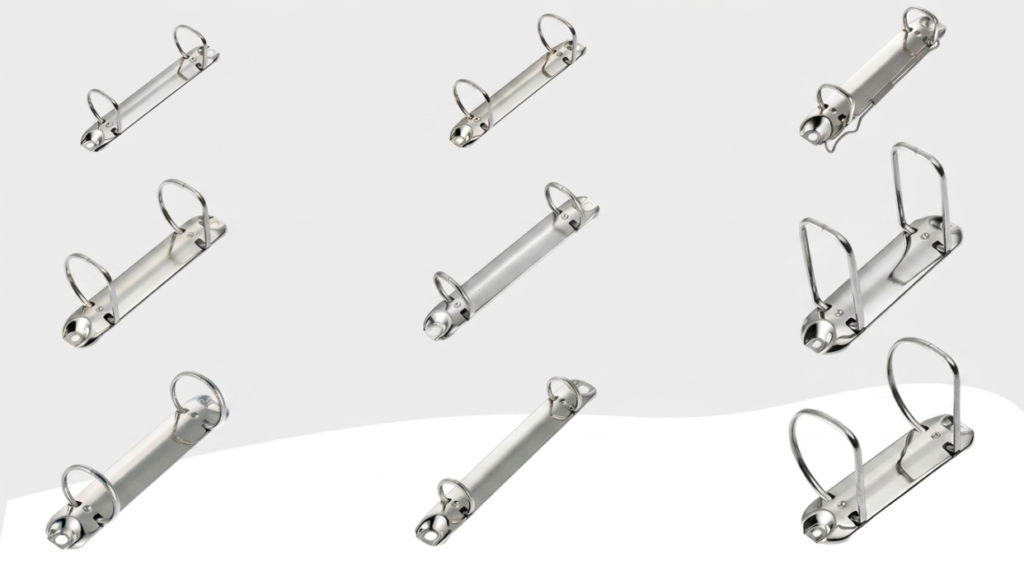
Key Specs: PR123 / PR133 Series
| Series | Ring Spacing (mm) | Inside Height (mm) | Overall Length (mm) | Base Width (mm) | Best For |
| PR123 | 80 | 11 – 38 | 123 | 15 – 20 | Lightweight contract folders, single-use filing |
| PR133 | 80 | 11 – 65 | 133 | 20 – 36 | Standard slim folders, low-volume archives |
Best product fit: economy folders, quick-file pockets, promotional binders with low page counts.
Data source: Jinxinyu Product Catalog, 2026 Edition
三、3-Ring Mechanism: The Universal Global Standard
The 3-ring mechanism is the world’s most widely used binder hardware, dominating office, education, and corporate markets across North America, Europe, and Asia. Three evenly spaced rings distribute page load symmetrically — ideal for A4 and US Letter paper in everyday use.
Jinxinyu offers two main base lengths: 200mm (standard A4) and 264/280mm (Letter/Legal and high-capacity variants).
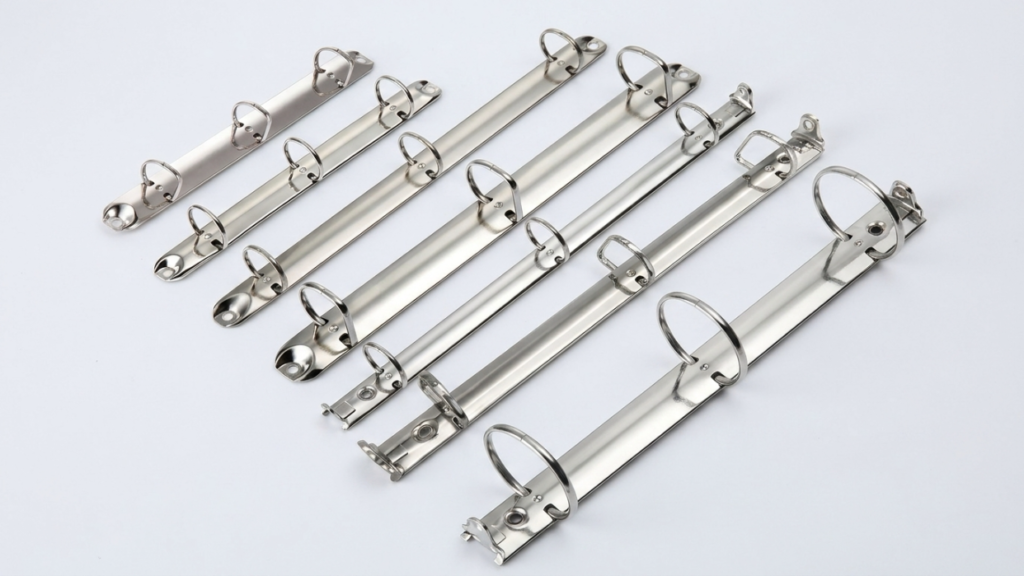
3-Ring Non-Booster: Core Specs
| Series | Ring Spacing (mm) | Inside Height (mm) | Overall Length (mm) | Base Width (mm) | Primary Market |
| PR210 | 70 / 70 | 12 – 35 | 200 | 20 – 26 | Europe, Asia (A4) |
| PR264 | 108 / 108 | 11 – 50 | 253 | 20 – 26 | North America (Letter/Legal) |
| PR280 | 108 / 108 | 11 – 65 | 270 | 20 – 36 | High-capacity archive binders |
3-Ring With Booster (Spring-Assisted): Core Specs
| Series | Ring Spacing (mm) | Inside Height (mm) | Overall Length (mm) | Base Width (mm) | Best Application |
| TR216 | 70 / 70 | 11 – 42 | 179.4 | 20 – 45 | Planners, diary notebooks |
| TR285 | 108 / 108 | 11 – 57 | 244 | 20 – 36 | Calendar binders, business notebooks |
Data source: Jinxinyu Product Catalog, 2026 Edition
四、4-Ring Mechanism: Maximum Stability for Heavy Binders
The 4-ring mechanism adds a fourth ring to the 3-ring layout, providing four evenly distributed support points that dramatically reduce page sag and lateral shifting. This is the go-to choice for binders holding 300+ sheets, legal files, and professional presentation folders.
The 4-ring format is especially popular in European markets — particularly Germany and the Netherlands — where premium archival binders are a standard office staple.
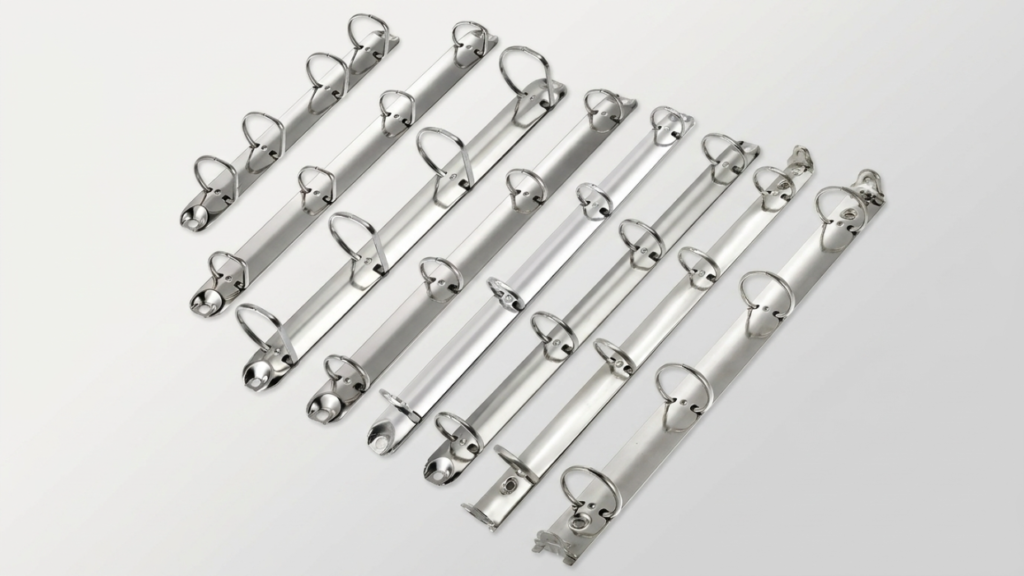
4-Ring Mechanism: Core Specs
| Series | Ring Spacing (mm) | Inside Height (mm) | Overall Length (mm) | Base Width (mm) | Best For |
| PR152 | 21 / 70 / 21 | 11 – 25 | 144 | 20 | Standard 4-ring archive binder |
| PR210 (4-ring) | 45 / 65 / 45 | 11 – 25 | 200 | 20 | Mid-size 4-ring folder |
| PR292 | 80 / 80 / 80 | 11 – 65 | 282 | 20 – 36 | High-capacity professional archive |
Data source: Jinxinyu Product Catalog, 2026 Edition
五、6-Ring Mechanism: The Planner and Diary Specialist
The 6-ring mechanism is purpose-designed for A5 and A6 notebooks, planners, and pocket diaries. Six compact rings distributed across a shorter base keep small-format pages perfectly flat and allow for a tight, satisfying page-turn experience that users of premium stationery expect.
The 6-ring format is the dominant standard in the Japanese, Korean, and European planner markets, used by brands like Filofax, Hobonichi, and Midori.
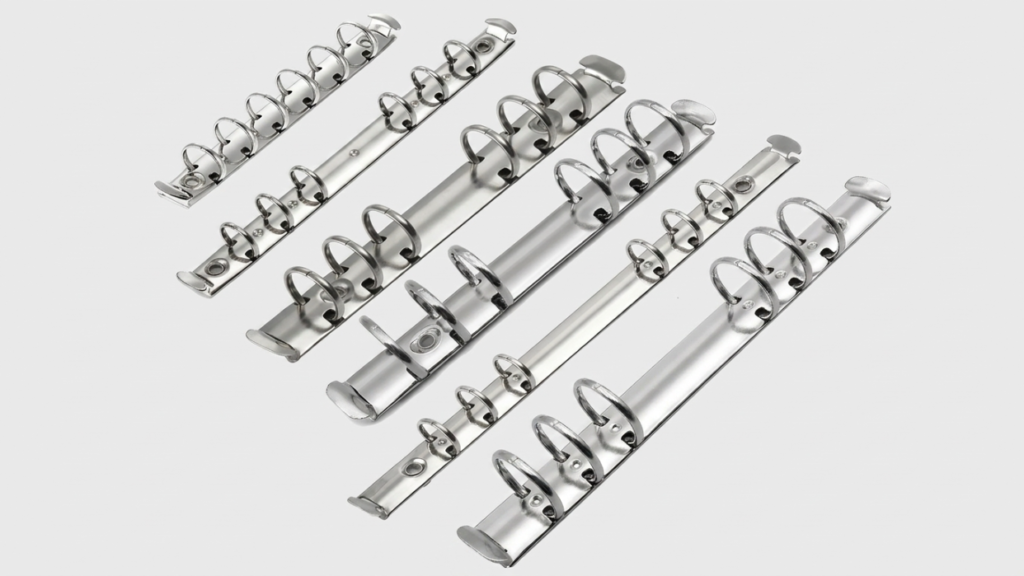
Multi-Ring With Booster: Core Specs
| Series | Ring Spacing (mm) | Inside Height (mm) | Overall Length (mm) | Base Width (mm) | Notebook Size |
| LTR130 | 19/19/19/19/19 | 12 – 19 | 110 – 132 | 15 – 20 | A6 / Pocket planner |
| LTR175 | 19/19/51/19/19 | 12 – 25 | 108 – 180 | 15 – 20 | A5 notebook |
| LTR216 | 19/19/70/19/19 | 12 – 25 | 174 – 225 | 15 – 20 | A5 large-capacity planner |
Data source: Jinxinyu Product Catalog, 2026 Edition
Side-by-Side Comparison: All Four Ring Types
| Feature | 2-Ring | 3-Ring | 4-Ring | 6-Ring |
| Paper Size | A4 standard | A4 / Letter / Legal | A4 high-capacity | A5 / A6 only |
| Stability Rating | Low | Medium | High | Medium-High |
| Capacity Range | Low to medium | Medium to high | High to very high | Low to medium |
| Typical Use Freq. | Infrequent archiving | Daily office use | Professional storage | Daily planner use |
| Relative Cost | Lowest | Medium | Higher | Medium |
| Key Markets | Asia, Southeast Asia | Global | Europe, North America | Japan, Korea, Europe |
| OEM Complexity | Simple | Standard | Standard | More complex |
Data source: Jinxinyu Product Catalog, 2026 Edition
Choosing by Target Market: A Regional Guide
| Target Market | Preferred Ring Count | Standard Paper Size | Sourcing Recommendation |
| North America (US/Canada) | 3-Ring | Letter (8.5″ x 11″) | Choose PR264/PR280 series, 108mm spacing |
| Europe (DE/FR/UK/NL) | 2-Ring or 4-Ring | A4 (210 x 297mm) | Germany favors 4-ring; UK/France use 2 or 3-ring |
| Asia (China/Japan/Korea) | 2-Ring or 6-Ring | A4 / A5 / B5 | Strong 6-ring demand in Japan/Korea planner market |
| Middle East / SE Asia | 2-Ring or 3-Ring | A4 primary | Price-sensitive; Non-Booster series recommended |
| Global E-commerce Brands | 3-Ring + 6-Ring | A4 / A5 dual-format | Stock both configs for widest coverage |
Data source: Jinxinyu export experience summary, 2026
六、FAQ: Ring Count and Selection
Q1: Is there a big price difference between 3-ring and 4-ring mechanisms?
Typically, a 4-ring mechanism costs 10%-20% more than a comparable 3-ring version, reflecting the additional ring, longer base plate, and extra material. For legal, medical, or professional archival products where stability is critical, the premium is well justified. For general office use, the 3-ring offers better value.
Q2: What is the difference between a 6-ring mechanism and a multi-ring mechanism?
A 6-ring mechanism specifically refers to the A5/A6 planner-standard layout with six small rings at fixed spacing. A multi-ring mechanism is a broader term covering 6 to 30+ rings used in loose-leaf notebooks, data binders, and large reference books. They serve different products and are not interchangeable.
Q3: Both PR210 and PR280 are 3-ring — what’s the actual difference?
The key difference is overall length and intended cover size. PR210 (200mm) fits a standard A4 cover board; PR280 (270mm) is designed for elongated covers or higher-capacity binders. Always match the mechanism length to your cover board dimensions, and confirm that rivet hole positions align before production.
Q4: My product needs to work with both A4 and US Letter paper — which spec should I choose?
Choose a 3-ring mechanism with 108mm ring spacing (such as the PR264 or PR280 series). This is the North American Letter standard and also fully compatible with A4 paper. It is the most universally compatible specification for products sold across multiple global markets.
Q5: Can I get samples before committing to a bulk order?
Yes. Jinxinyu Hardware provides samples for all ring mechanism configurations — 2-ring, 3-ring, 4-ring, and 6-ring. Sample lead time is typically 3-5 business days for standard specs. For custom color or size samples, allow 7-10 business days. Contact our sales team directly for a sample request.
Q6: Are custom finishes available across all ring counts?
Yes. All Jinxinyu ring mechanism series — 2, 3, 4, and 6-ring — are available in a full range of surface finishes: bright nickel, gold, rose gold, antique brass, matte black, bright blue, bright red, and more. Custom Pantone-matched colors are also available for OEM orders. Minimum quantity applies per color.
Q7: How do I confirm a ring binder mechanism meets export compliance standards?
For export to Europe and North America, the key certifications are RoHS (restriction of hazardous substances including lead and mercury) and REACH compliance. Jinxinyu has passed both RoHS testing and 48-hour salt spray testing, and can provide official test reports with every order to support your import documentation.
All specifications in this article are sourced from the Jinxinyu Hardware Product Catalog (2026 Edition) and regional export experience. For samples, pricing, or OEM inquiries, contact us directly.
Website: https://newworldstationery.com/
Alibaba International: https://jinxinyu.en.alibaba.com/
Email: michelle@jxystationery.com